An hour that ends
A case has a last page. There is no next episode and no autoplay, so nobody has to be talked down off a device when it finishes.
ABOUT THE AUTHOR
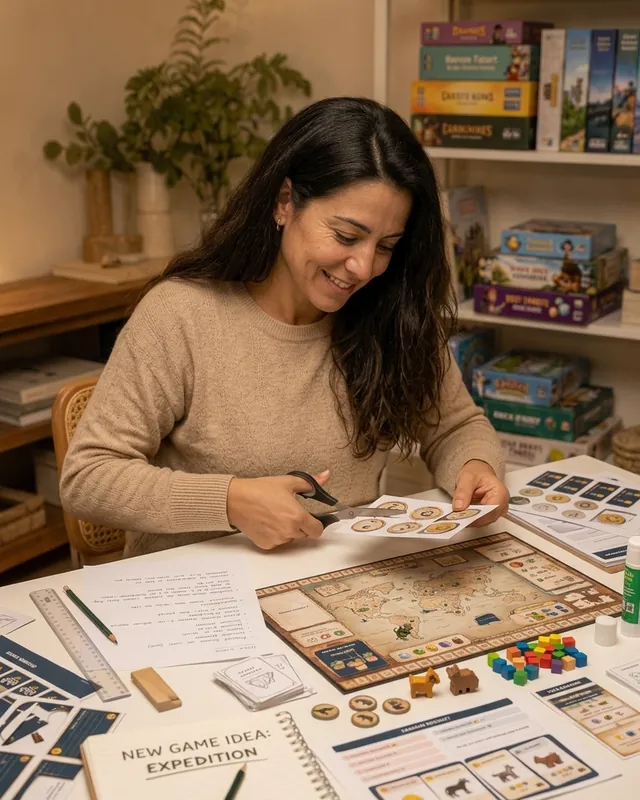
I draw and cut them out here, at a work table wedged between a window and a shelf of other people’s games. Then I carry them twenty steps to the kitchen table, where my two children used to sit with their screens, and find out whether they actually work.
WHY THIS EXISTS
Four of us around the kitchen table, four screens, and nobody had said a word in forty minutes. Nothing dramatic — no one was in trouble, nothing had gone wrong. That was the part that bothered me. Dinner had quietly stopped being dinner and turned into four separate evenings happening at the same table.
Telling children to put a device down almost never works, because you are asking them to swap something engineered to be interesting for nothing in particular. So I stopped asking, and made something interesting instead. The first case was five sheets of paper, a stolen museum stone, four suspects and a code I wrote badly. I laid it out on that same table, over the same crumbs. My kids solved it in fifty minutes and immediately asked when the next one was coming.
Nobody had to be told to put a phone down. The clues were on the table, and the table was more interesting.
That is the whole idea behind Clue Harbor Games. Not a lecture about screen time — just an hour that is better than the hour it replaces. An hour with a beginning, a hard middle, an ending, and four people leaning over the same piece of paper instead of four separate screens.
These days the writing happens a few steps away, at a work table buried in prototypes, rulers and half-cut cards. But every case still comes back to the kitchen to be tested. The puzzles have to be solvable by a nine-year-old and interesting enough that the adults stop pretending to help. When something stalls the room for the wrong reason, it gets rewritten before anyone else ever sees it.
— Jane, Clue Harbor Games
AN HOUR WITHOUT SCREENS
These are not clinical claims — they are the things I watch happen at my own table, and the reasons I keep making cases instead of apps.
A case has a last page. There is no next episode and no autoplay, so nobody has to be talked down off a device when it finishes.
Children read the clue card three times because the answer is hidden in it — not because anyone asked them to read carefully.
Puzzles that need a group turn quiet children into negotiators. Somebody has to say the theory before the table can test it.
Cutting, folding and sealing the clues is half the fun. Kids who help prepare a case play it differently: they own it.
Every case has one puzzle that resists. Getting through it together is a small, specific memory of not giving up.
Screens rarely survive breakfast. “Remember when Ellie spotted the fingerprint” survives for years.
THE SCISSORS PART
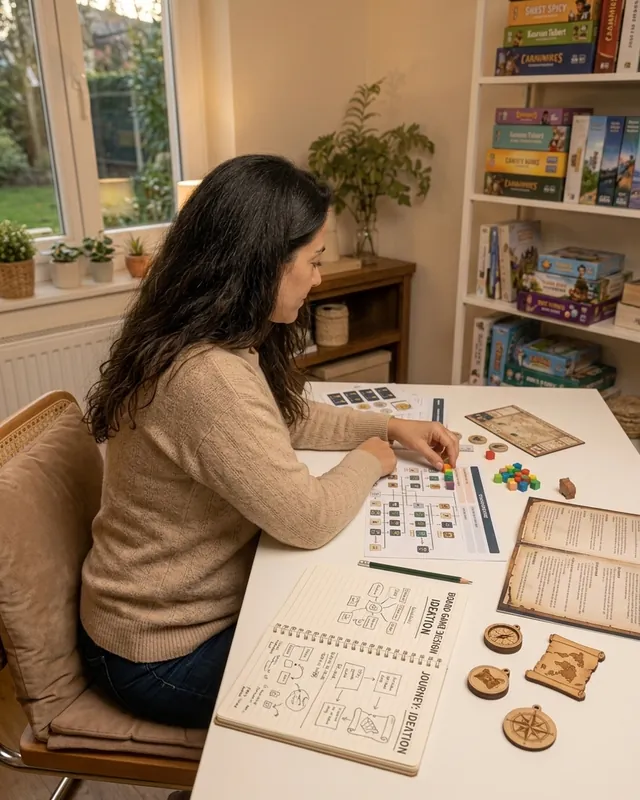
This is where the cases get made: a work table between a window and a shelf of other people’s games, permanently covered in prototypes, rulers and half-cut cards. Everything that ends up in your PDF was cut out here first — badly, and at least twice.
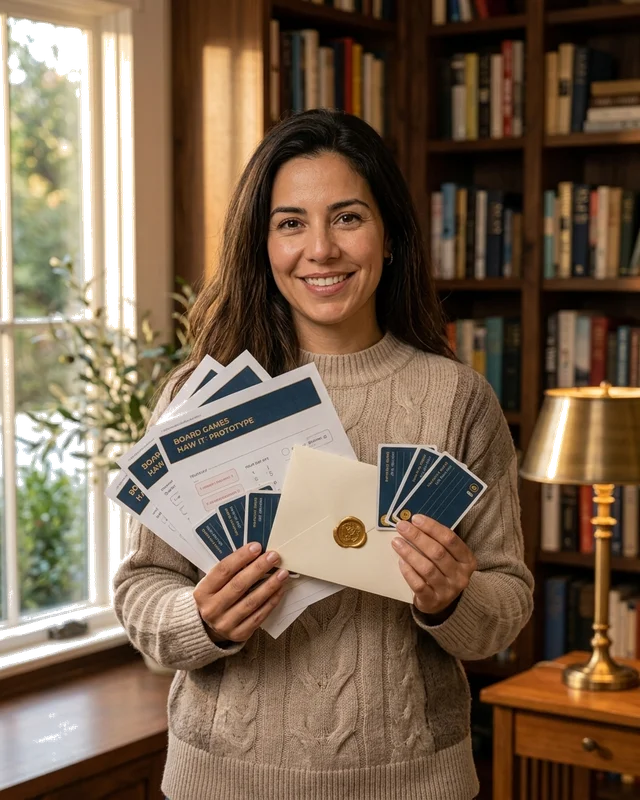
It arrives at your end the same way. Clue cards, suspect boards, sealed envelopes, keepsake bookmarks — all of it comes off the printer flat and becomes a real object on the kitchen table because somebody sat down with a pair of scissors.
I could have made that step disappear. I kept it on purpose. Children who help prepare a case play it differently: they handle the evidence like it belongs to them, and the twenty minutes of cutting and folding is the calmest part of the whole evening.
“You bring the printer. We bring the mystery.”
IN YOUR HANDS
Everything in your PDF was made here first — badly, and at least twice — then sent to you flat. You print it, spread it across the table, and the last twenty minutes of prep is yours to keep. Kids who help cut the cards own the mystery differently: they handle the evidence like something they built.
This is the part that stops a case from being another screen. Your hands on the paper, your scissors through the seals, your pencil marking the clues. By the time anyone sits down to play, the house already smells like the game.
“Print it. Cut it. Solve it.”
BETTER WITH MORE PEOPLE
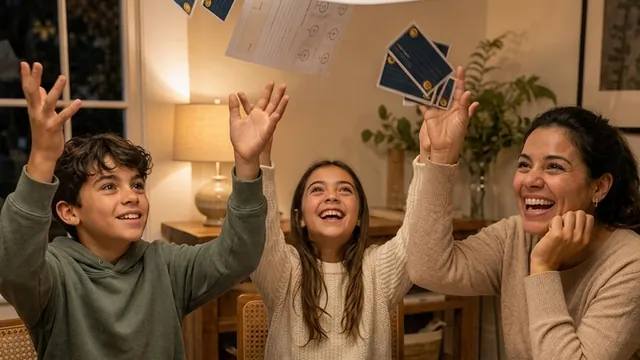
A mystery gets better the more heads are around the table — and a small studio grows the same way, one parent telling another.
THE USUAL QUESTIONS
A small independent studio of parents, writing under the name Jane. Every case is designed, illustrated and playtested in-house before it goes on sale.
Because the point is the hour away from the screen. Paper can be cut, folded, passed across a table and argued over. A tablet turns four players into one player and three spectators.
They replace an hour of scrolling with an hour that has a beginning, a middle and an ending everyone remembers. Nobody has to be told to put a device down — the clues are already on the table.
Yes. One printed case works for two to six detectives, so inviting another family or a couple of school friends is the cheapest way to make it a proper event. One purchase covers one household or one classroom.
A note on Jane. Jane is a pen name — the voice of the small independent studio that designs, plays and tests these games. We write as her because the reasons are hers as much as ours. The puzzles, the playtests and the paper are entirely real; the surname is not.